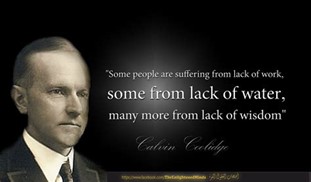
Calvin Coolidge had some unique characteristics. He was a small government president and was the only U.S. president born on July 4th. That is somewhat symbolic of his small-government view. One biographer wrote, “He embodied the spirit and hopes of the middle class.”
President Coolidge was said to be able to interpret the longings of the people and articulate their opinions. His reputation and standing in history are divided. Some applaud his reduction of the size of government, and those who believe that government should be more directly involved in regulating and controlling the economy.
President Coolidge succeeded Warren G. Harding upon Harding’s death in 1923 and was elected in his own right in 1924. President Coolidge was instrumental in restoring confidence to the White House after the scandals of the Harding administration. Imagine a President restoring confidence in the White House rather than producing more and more scandals and usurpations of the Constitution.
Interestingly, in our American history, the office of the Vice President has carried few official duties. One former Vice President said, “The job of Vice President is worth about as much as a cup of warm spit.”
That is certainly not very complimentary of the office one heartbeat away from the Oval Office. But an attitude held by many Presidents, Vice Presidents, and voters. In our modern history, many are utterly ambivalent about who the vice president is. There is no expectation or contemplation that something could happen to the sitting President. We know it, but refuse to think about it.
Conversely, I have always been greatly concerned about who occupies this position for those very reasons. Coolidge was the first Vice President to be invited to Cabinet Meetings by the President. He became known as “Silent Cal” despite being a skilled and compelling public speaker.
It is reported that at a dinner party, Dorothy Parker was seated next to him and said, “Mr. Coolidge, I’ve made a bet against a fellow who said it was impossible to get more than two words out of you.” Coolidge famously replied, “You lose.” That same Dorothy Parker is reported to have said upon receiving the news that Coolidge had died remarked, “How can they tell?”
Coolidge’s Vice President was former Brigadier General Charles G. Dawes, who won the Nobel Peace Prize in 1925. Coolidge was very non-confrontational in his style but decisive and would act quickly when the need arose. He and Dawes won every state outside the South except for Wisconsin, the home of the home of Robert M. La Follette, Sr., a former Republican Senator.
Dawes split from the GOP to form a New Progressive Party that most thought would destroy the Republican Party. The Democrats believed this third party would be their ticket to the White House, but as it turned out, Coolidge won a popular majority of 2.5 million votes over his opponents combined.
The economy grew rapidly under Coolidge, and the period became known as the “Roaring Twenties.” He largely left the industrial policy in the hands of his Secretary of Commerce, Herbert Hoover, and, except for favoring higher tariffs, Coolidge opposed regulation or over-regulation by the federal government.
His commissioners to the Federal Trade Commission and the Interstate Commerce Commission were anything but intrusive overseers and allowed private industry to follow the Free Market. Coolidge’s economic policy could be and should be viewed in the reflection of his statement in 1925, in which he addressed the American Society of Newspaper Editors.
He said, “…it is probable that a press which maintains an intimate touch with the business currents of the nation is likely to be more reliable than it would be if it were a stranger to these influences. After all, the chief business of the American people is business. They are profoundly concerned with buying, selling, investing, and prospering in the world.”
Coolidge believed that taxes should be lower and that fewer people should have to pay them. He cut taxes and grew the economy while proposing reductions to federal expenditures and retiring as much of the federal debt as possible.
The result was the passage of the Revenue Act of 1924, which reduced income tax rates and eliminated all income taxes for well over 2 million people. He reduced taxes again in 1926 and 1928 while keeping spending down and reducing the national debt. Something that we are told by Barack Obama, Joe Biden, the Democrats, and too many Republicans is not possible. It is; it has been done and can be done again.
Coolidge spoke strongly in favor of the civil rights of African Americans and Catholics and is NOT KNOWN to have appointed any members of the Ku Klux Klan to office. History tells us that the Klan lost most of its influence during his term.
In 1924, Coolidge received and responded publicly to a letter that claimed the United States was a “white man’s country.” His response was, “…I am amazed to receive such a letter. During the war, 500,000 colored men and boys were called up under the draft, not one of whom sought to evade it. [As president, I am] one who feels a responsibility for living up to the traditions and maintaining the principles of the Republican Party. Our Constitution guarantees equal rights to all our citizens, without discrimination on account of race or color. I have taken my oath to support that Constitution….”
That flies in the face of the claim that the Democratic Party is the Party of Civil Rights. Facts reveal that it has been the Republicans who have done more for civil rights from Lincoln to now than any of the Democrats, including and especially Barack Obama or Joe Biden. They did much damage and uncut much of what had been accomplished previously. The continual fanning of the flames of hate and distrust is a recipe for chaos.
Coolidge was not an isolationist but was always hesitant to involve the United States in foreign conflicts. In the summer of 1927, he announced that he would not run for a second term because ten years in Washington was too long for any man.
Would that we had such men today who would reject the appeal of professional politics and seek office to truly be a servant of the people, the nation, and honor the Constitution. He said of Hoover, who succeeded him, “For six years, that man has given me unsolicited advice – all of it bad.” Yet, he would not go public in his disapproval of Hoover; not wanting to split the party, he remained silent publicly.
Calvin Coolidge was one of the few and one of the last Presidents to actually work toward having a smaller, less intrusive federal government. I long for that time and that kind of politician to return.
May God bless you, and may God bless America again!
 Roybeaird's Blog